
Ming Chu
Healthcare IT and Machine Learning Researcher
Bozeman, Montana
by Ming Chu
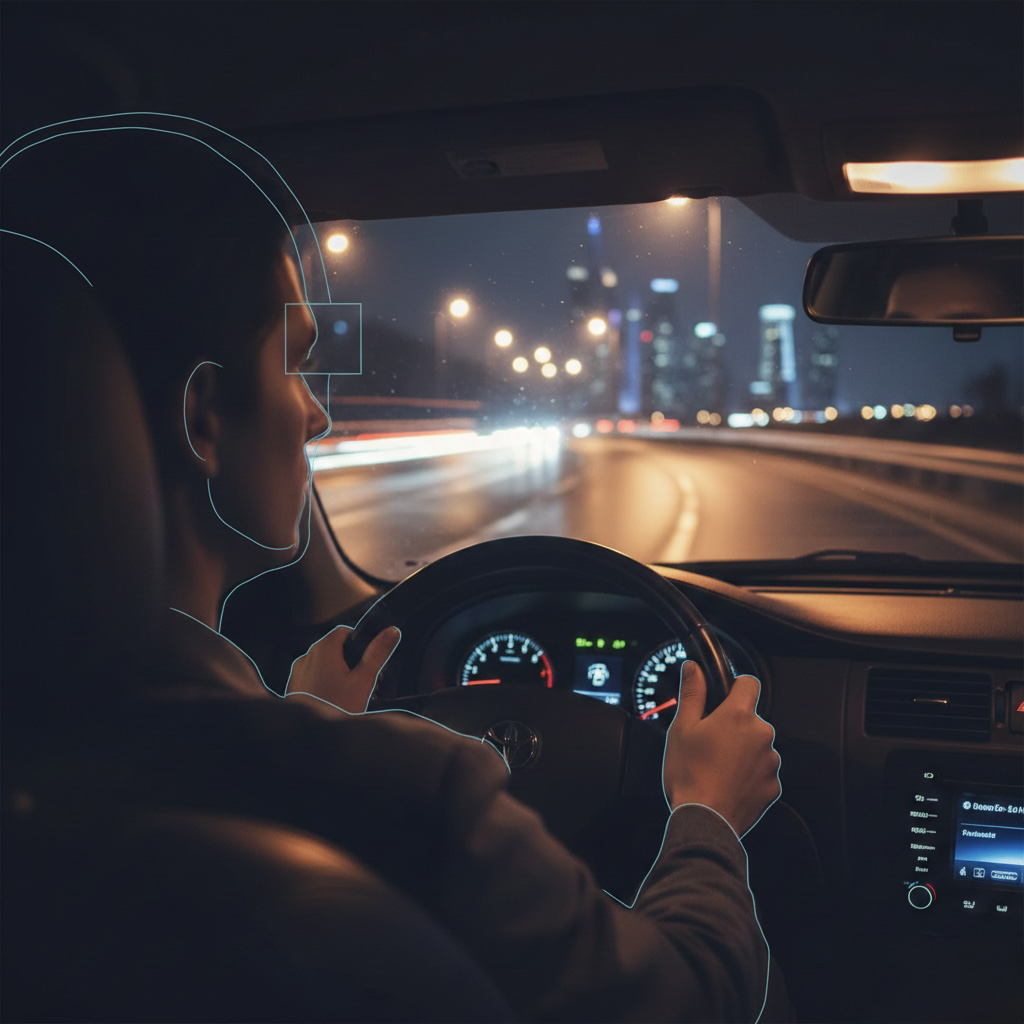
It is late at night.
Your eyelids grow heavy.
Your phone buzzes.
For a few seconds your attention drifts, but the car does not stop moving.
In those moments, a split second decides lives.
That is what drove my graduate research.
Build an AI assistant that sees distraction or fatigue in real time and alerts the driver before it is too late.
This project began as my graduate research and became the focus of my 3-Minute Thesis presentation.
In the 3-Minute Thesis competition, I shared how computer vision and deep learning can detect distraction and drowsiness inside the car.
The research was later published in the Journal of Big Data:
Comprehensive Study of Driver Behavior Monitoring Systems Using Computer Vision and Machine Learning Techniques
The system reached 99.1% accuracy on benchmarked datasets under controlled conditions.
It was a strong step toward safer roads.
Think of the AI system as two teammates.
One watches the driver’s head position, hand position, and posture.
The other remembers how those movements change over time.
Technically, these are:
Convolutional Neural Networks, CNNs.
Bidirectional Long Short-Term Memory, BiLSTMs.
CNNs recognize spatial patterns.
BiLSTMs track how those patterns change over time.
Together they can catch the quick gaze shift.
Hands leaving the wheel.
A body starting to collapse from fatigue.
If placed in vehicles, this system could prevent accidents caused by human error.
It could improve Advanced Driver Assistance Systems.
It could add a layer of safety for semi-autonomous and autonomous driving.
This is not surveillance.
No identity tracking. No behavioral profiling.
It is assistance. A second set of eyes for the road.
There is still more to do.
The next step is training Vision Transformers on large, real-world driving datasets.
That means better accuracy in complex environments.
Better adaptation to weather and regional differences.
Stronger safety when combined with radar, LiDAR, and biometric data.
This project taught me how to design and tune deep learning models.
It taught me how to explain complex ideas in plain language.
And it taught me that technology is worth building only when it serves people.
But even the best system cannot watch over us perfectly.
“He who keeps you will not slumber. Behold, He who keeps Israel shall neither slumber nor sleep.”
There is One who never sleeps and never looks away.
He guards our steps.
And in Him we find true safety.
3MT Presentation: Machine Learning for In-Cabin Vehicle Safety